The State of Workplace Benefits Report: What Workers Value Most
We surveyed 2,041 full-time U.S. employees about which workplace benefits they value most, what they would trade for better coverage, and how their priorities change with age and life stage.
BenefitFlow Content Team · October 26, 2026
For most people, the decision to accept a job offer comes down to more than just salary. Health insurance, retirement contributions, paid leave, and flexibility all play a part in whether a job is worth taking, and worth keeping.
But not all benefits carry the same weight, and workers’ priorities can change depending on age, family responsibilities, and where they are in their careers.
To learn which benefits employees consider most important in their employment decisions, we surveyed 2,041 full-time U.S. employees about what they value, what they would trade for better coverage, and how their priorities change with age and life stage.
Key Highlights:
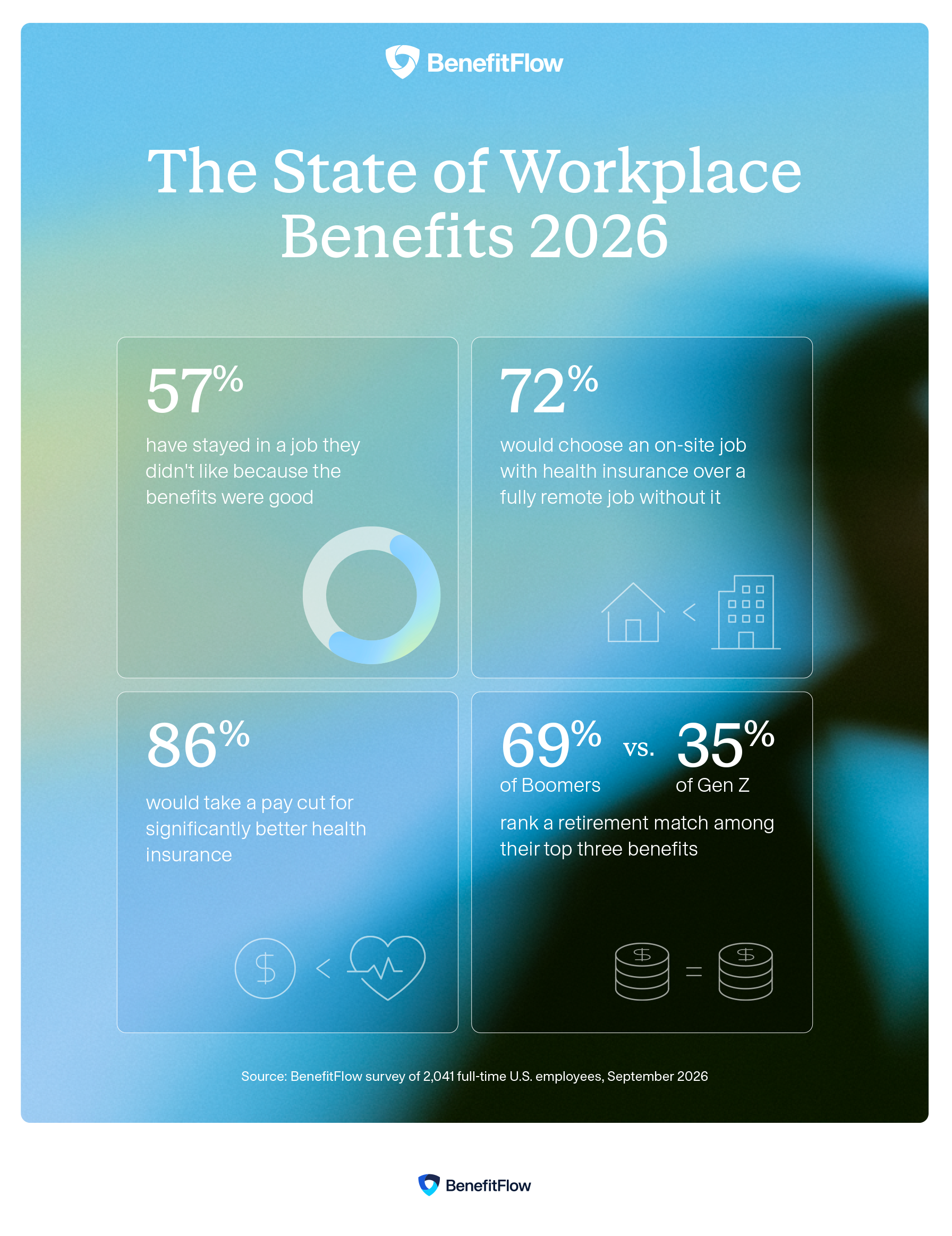
- More than half (57%) have stayed in a job they didn't like because the benefits were good.
- 86% would take a pay cut for significantly better health insurance, giving up nearly 8% of their salary on average.
- 72% would choose an on-site job with health insurance over a fully remote job without it.
- 69% of Baby Boomers rank a retirement match among their top three benefits, compared to 35% of Gen Z.
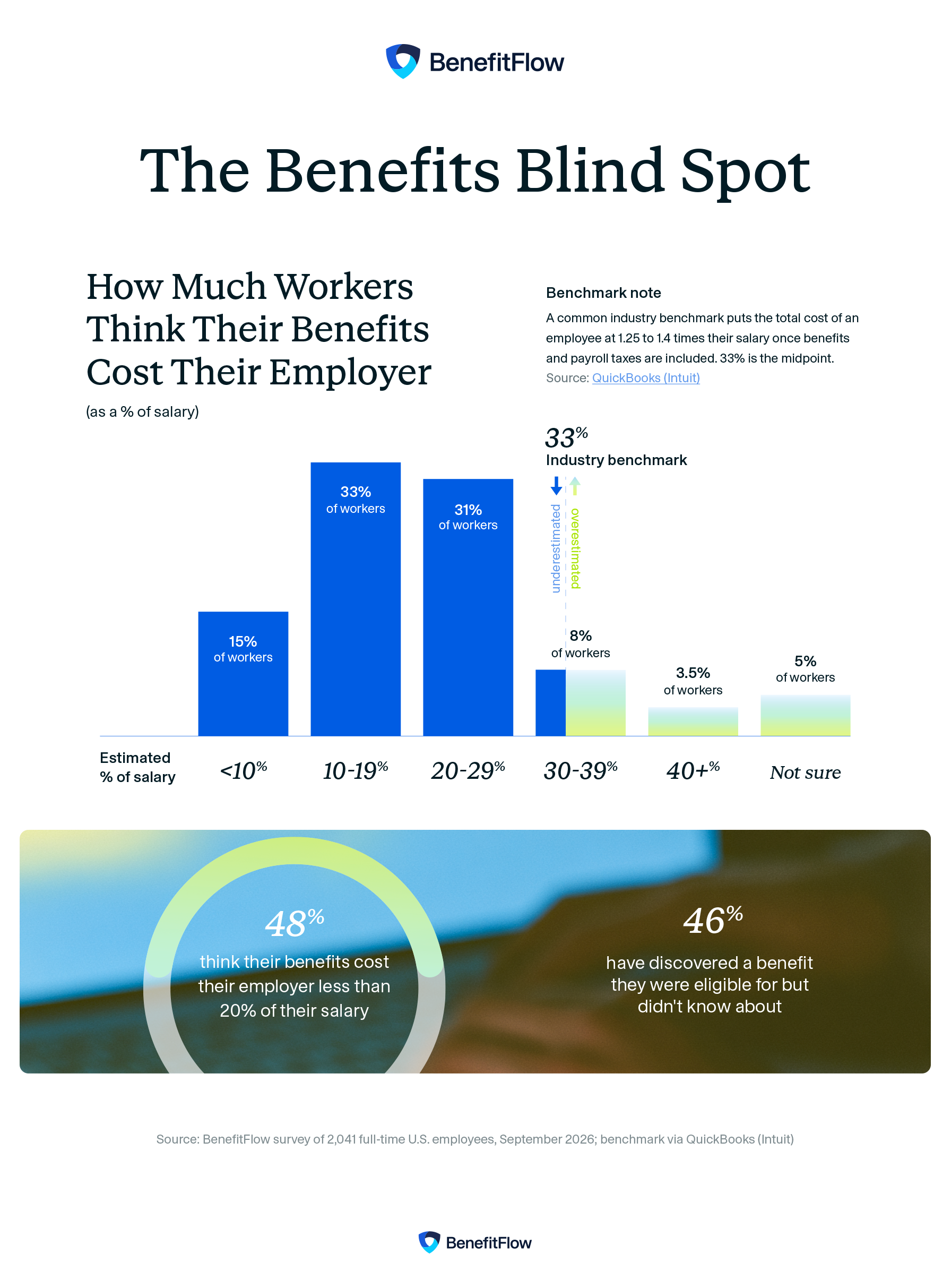
- Nearly half (48%) think their benefits cost their employer less than 20% of their salary. QuickBooks estimates benefits and payroll taxes add 25% to 40% to an employee’s base salary, or about 33% at the midpoint.
What Workers Value Most in Their Benefits
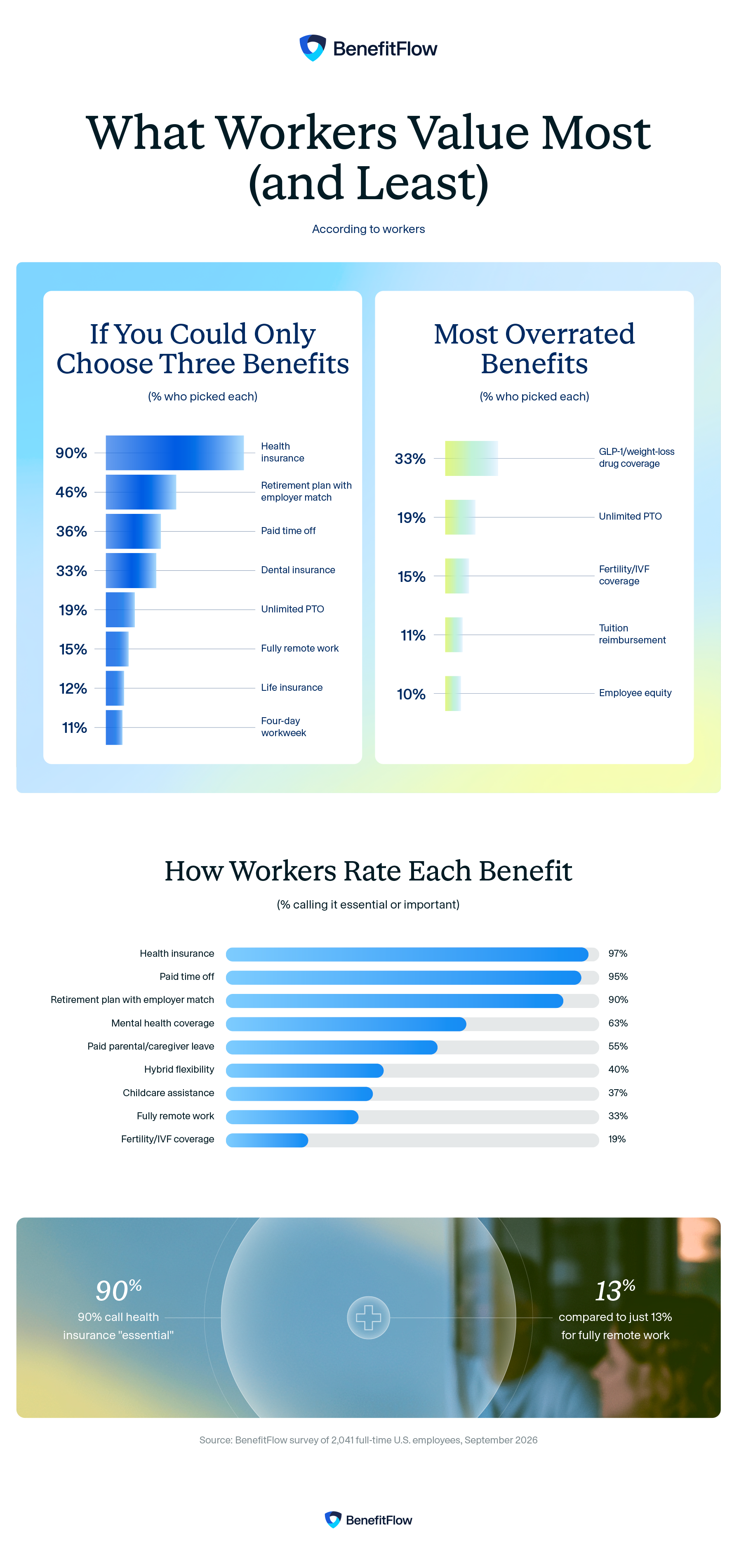
When asked to pick just three workplace benefits, 9 in 10 workers (90%) chose health insurance, followed by a retirement plan with an employer match (46%), paid time off (36%), and dental insurance (33%). Fewer than 1 in 5 picked unlimited PTO (19%) or fully remote work (15%).
Along with basic benefits, respondents also emphasized the importance of mental health benefits. Nearly two-thirds of workers (63%) said mental health benefits are essential or important, including 70% of women and 53% of men. More than half (55%) say the same about paid parental or caregiver leave, while fewer rate childcare assistance (37%) or fertility and IVF coverage (19%) as highly.
Some newer benefits haven't caught on. One-third of workers (33%) consider GLP-1 or weight-loss drug coverage overrated, more than any other benefit, followed by unlimited PTO (19%) and fertility or IVF coverage (15%).
What Workers Would Trade for Better Benefits
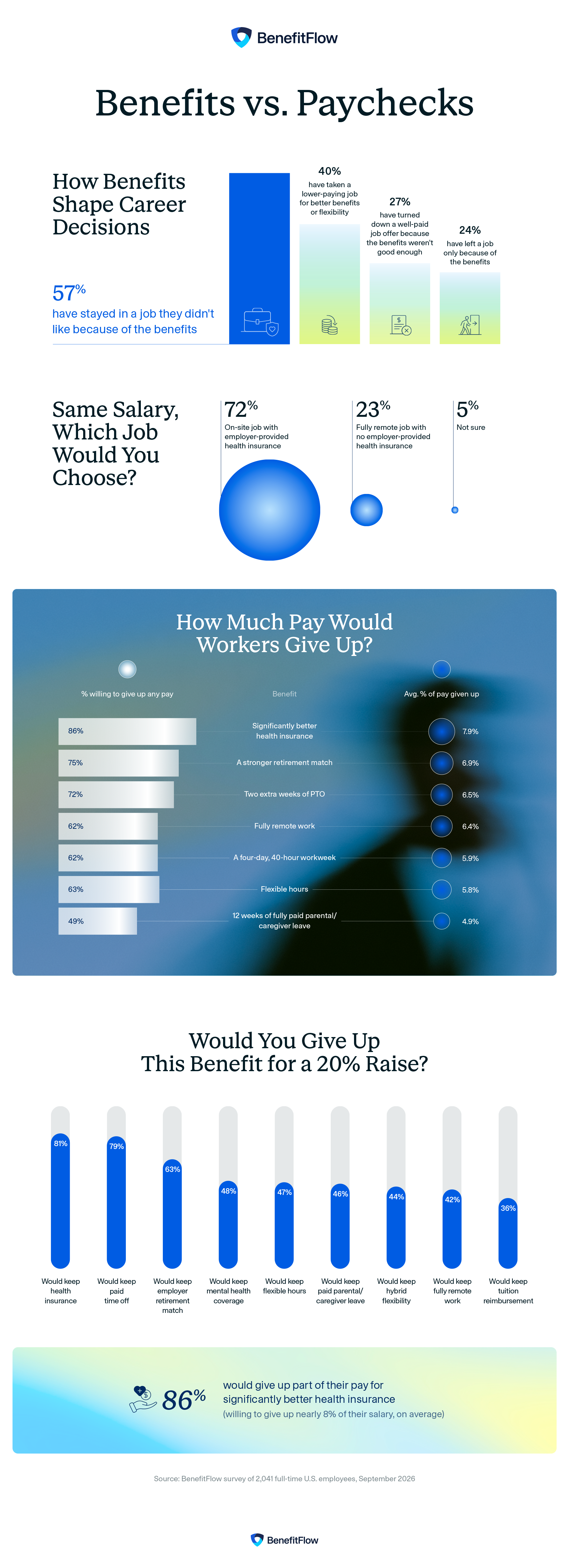
For many workers, benefits carry as much weight as salary. More than half (57%) have stayed in a job they didn't like because the benefits were good, and 40% have taken a lower-paying job for better benefits or flexibility. More than 1 in 4 (27%) have turned down a well-paying offer because the benefits fell short, most often because of health insurance (59%).
Furthermore, a majority of workers would take a pay cut for a specific benefit. More than 8 in 10 (86%) would accept a lower salary for significantly better health coverage. We also asked workers how much of their annual pay they would give up for certain benefits, assuming the jobs were otherwise the same. Health insurance came out on top, with respondents willing to give up nearly 8% of their salary on average. A stronger retirement match (6.9%) and two extra weeks of PTO (6.5%) came next, with fully remote work close behind (6.4%). Workers would give up less pay for a four-day, 40-hour week (5.9%), flexible hours (5.8%), or 12 weeks of fully paid parental or caregiver leave (4.9%).
Health insurance outweighs remote work in other ways, too. Given two jobs with the same salary, 72% would choose an on-site job with health insurance over a fully remote job without it. And if offered a 20% raise to give up a benefit entirely, 81% would keep their health insurance, while 58% would give up fully remote work.
How Benefit Priorities Change With Age and Life Stage
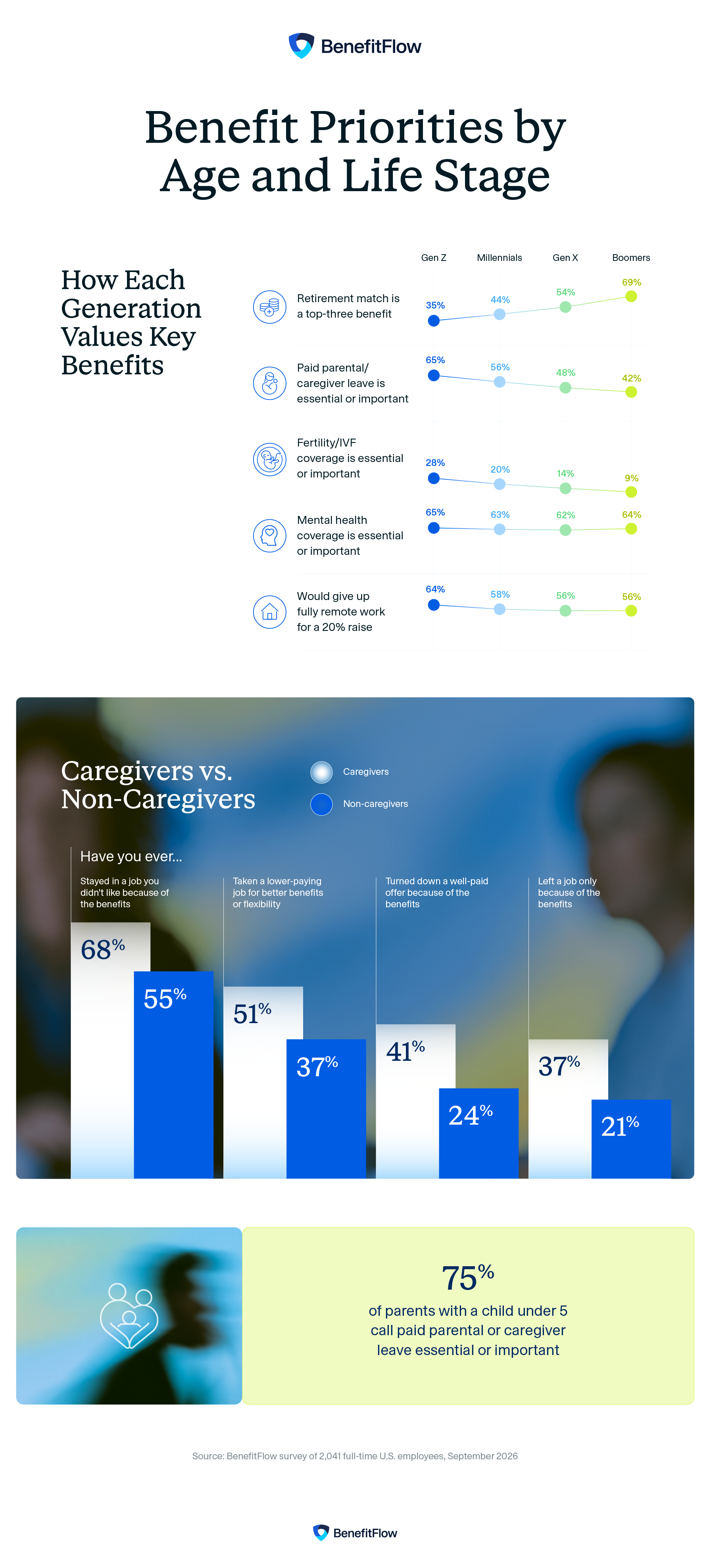
Some priorities are closely tied to age. Interest in a retirement match rises with each generation: 69% of Baby Boomers put it in their top three, compared to 54% of Gen X, 44% of Millennials, and 35% of Gen Z. Younger workers aren't ignoring retirement, though. 87% of Gen Z still call a retirement match essential or important.
Younger workers place more value on family-related benefits. Paid parental or caregiver leave is essential or important to 65% of Gen Z, compared to 42% of Boomers. Gen Z is also three times as likely as Boomers to value fertility or IVF coverage (28% vs. 9%).
Other results don't fit the usual stereotypes. According to the report, Gen Z workers are the least likely to call fully remote work essential or important (28%) and the most willing to give it up for a 20% raise (64%). Mental health coverage is one area where every generation agrees, with 62% to 65% of each calling it essential or important.
Life stage often matters more than age. Adult caregivers are more likely than non-caregivers to have stayed in a job they disliked because of the benefits (68% vs. 55%), taken a lower-paying job for better benefits (51% vs. 37%), and left a job over benefits (37% vs. 21%). Across generations, by comparison, the share who have left a job over benefits ranges only from 18% to 25%. Parents of young children follow the same pattern. Among those with a child under 5, 75% call paid parental or caregiver leave essential or important, and 73% would give up some pay for 12 weeks of fully paid leave.
The Benefits Blind Spot
Workers value their benefits, but many don't know what those benefits cost or everything they include. When asked to estimate what their benefits cost their employer on top of their salary, nearly half (48%) guessed less than 20%, and 80% guessed less than 30%. A common industry benchmark puts the total cost of an employee at 1.25 to 1.4 times their salary once benefits and payroll taxes are included. At the midpoint, that's about 33% on top of salary.
Nearly half of workers (46%) have also discovered a benefit they were eligible for but didn't know about.
Open Enrollment Stress and Rising Costs
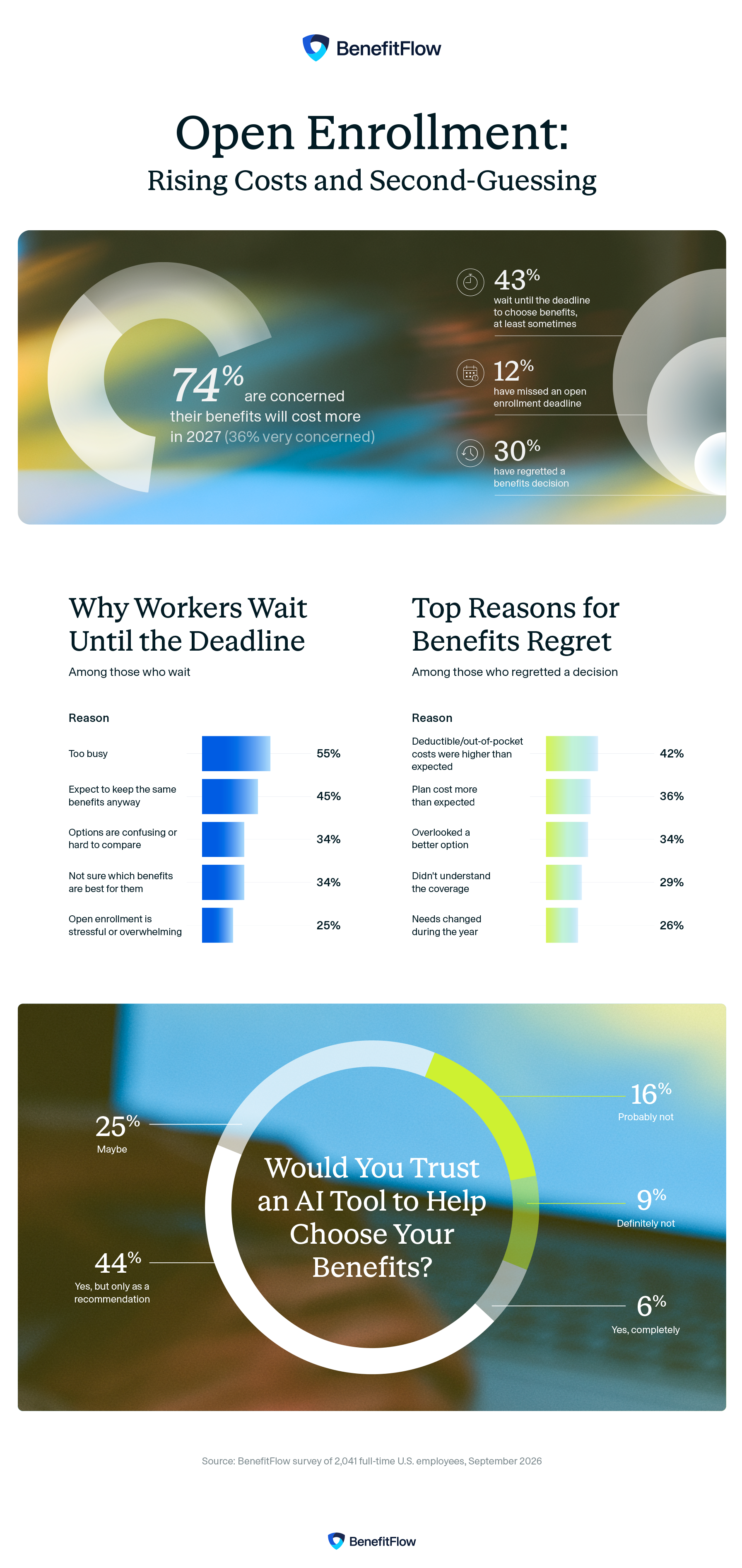
Workers are heading into open enrollment worried about cost. Nearly 3 in 4 (74%) are concerned their benefits will cost more in 2027, including 36% who are very concerned. Baby Boomers are the most worried, with half (50%) very concerned.
More than 4 in 10 (43%) wait until the deadline to choose their benefits at least some of the time, most often because they're busy (55%) or expect to keep the same benefits anyway (45%). Nearly 1 in 3 (30%) have regretted a benefits decision, most often because their deductible or out-of-pocket costs were higher than expected (42%).
Half of workers (50%) would trust an AI-powered tool to help choose their benefits, though most would use it only as a recommendation. Boomers are more open to the idea than Gen Z (62% vs. 45%).
From health insurance to paid leave, benefits continue to shape where people work and how long they stay. And as needs shift with age, family, and caregiving, the benefits that matter most can shift as well.
Methodology
In September 2026, we surveyed 2,041 full-time U.S. employees about their workplace benefits, including what they value most, the trade-offs they would make between pay and benefits, and how they approach open enrollment.
Gender: Women (59%), Men (40%), Nonbinary (1%), Prefer not to say (<1%)
Average age: 41
Generation: Gen Z, ages 18–29 (17%), Millennials, ages 30–45 (51%), Gen X, ages 46–61 (28%), Baby Boomers, ages 62+ (4%)
Income levels: Under $25,000 (2%), $25,000–$39,999 (9%), $40,000–$54,999 (16%), $55,000–$69,999 (18%), $70,000–$84,999 (15%), $85,000–$99,999 (10%), $100,000–$124,999 (12%), $125,000–$149,999 (7%), $150,000–$199,999 (6%), $200,000+ (4%), Prefer not to say (1%)
Relationship status: Married (46%), Single (30%), Living with a partner (14%), Separated/divorced (9%), Widowed (1%)
Work arrangement: On-site (54%), Hybrid (28%), Fully remote (18%)
Total respondents: 2,041
Margin of error: +/- 3%