
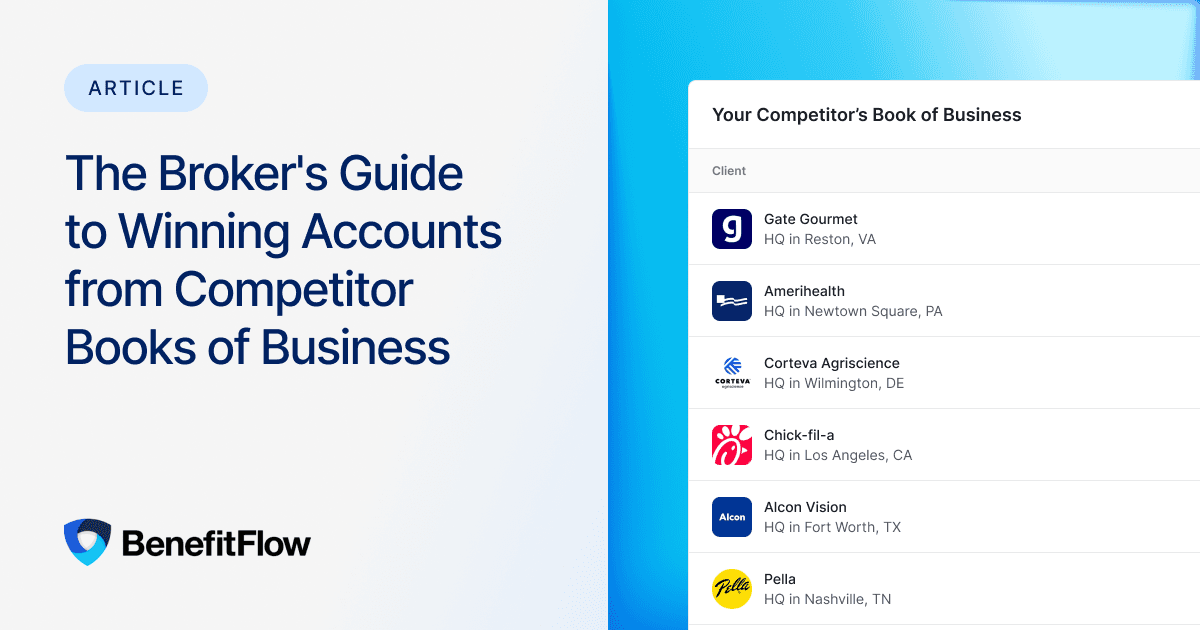
Every employer in your territory already has a benefits broker. That's not an obstacle. It's information. If you know who the incumbent broker is, which office serves the account, what carriers they've placed, when the renewal is coming up, and whether the employer's employees are happy with their benefits, you're not cold calling. You're making a targeted, informed approach to an account where you can add specific value.
Most benefits brokers prospect by geography, industry, or employer size. Those are reasonable starting filters. But the brokers who consistently win new business go a step further: they study their competitors' books of business, identify the accounts where they can offer something the incumbent isn't delivering, and time their outreach to the window when employers are most open to a conversation.
This approach works because all the data that powers it is publicly available through Form 5500 filings. Every employer with 100 or more participants in a health and welfare plan is required to report their carriers, premiums, commissions, and broker of record to the Department of Labor. That filing creates a transparent record of who's serving whom, at what cost, and on what timeline. The challenge has always been accessing, organizing, and acting on that data efficiently. Here's how to do it.
1. Start with the Broker, Not the Employer
The natural instinct in prospecting is to start with a list of employers and work outward. That works, but it's not the most efficient path to new accounts. Starting with the competitor broker gives you a structural advantage: instead of evaluating employers one at a time, you're analyzing an entire book of business at once.
Here's what you can learn from a competitor broker's public filings:
Office-level market share. Form 5500 data, when aggregated at the broker office level, reveals how each office ranks by commissions within its metro area and state. This tells you whether an office dominates its local market or has a thinner foothold. Offices with smaller market share in a competitive metro are more vulnerable to losing accounts than dominant players with deep relationships.
Client mix by size and funding type. You can see the breakdown of a broker office's clients by employer size and by funding model (fully insured versus self-funded). This composition tells you what kind of broker the office is. A book concentrated in large self-funded groups requires different expertise than a book of small fully insured accounts. If their mix doesn't match their apparent capabilities, some accounts may be underserved.
Growth trajectory and retention. Year-over-year client count trends, net new client adds, and retention rates tell you whether an office is growing, plateauing, or losing ground. An office that's been shedding clients for two or three consecutive years may have service issues that are creating openings across its book. Conversely, a rapidly growing office may be stretched thin, which creates its own kind of service gap.
Carrier and vendor relationships. 5500 filings show which carriers a broker office places the most premium with, broken down by medical and ancillary lines. If a broker office is heavily concentrated with a single carrier, their clients may not be seeing the full market. That's an angle you can use in your outreach: "Are you confident your current broker has shown you every option, or are they placing most of their book with one carrier?"
2. Identify the Accounts Worth Pursuing
Not every account in a competitor's book is worth your time. The goal isn't to go after all of them. It's to identify the subset where you have a genuine competitive advantage and a realistic path to a conversation.
Filter by your ideal customer profile. Start with the basics: employee count, geography, industry, and funding type. If your firm excels with self-funded groups in the 200 to 500 employee range, filter the competitor's book to those parameters. There's no value in pursuing accounts that don't fit your strengths.
Look for low employee benefits ratings. Employee review platforms generate a steady stream of sentiment data about how workers perceive their employer's benefits. Employers with low benefits satisfaction scores are more likely to be open to a broker conversation, because the dissatisfaction often reflects real pain: confusing plan designs, poor carrier service, inadequate coverage, or benefits that haven't been re-evaluated in years. A low rating doesn't guarantee a broker change, but it signals that the current arrangement isn't working for employees.
Check for recent broker or carrier changes. An employer's 5500 filing history shows when the broker of record changed and when carriers were swapped. An employer that recently changed brokers may be locked in for a while. But an employer that has stayed with the same broker for 10 years and hasn't changed carriers in that time may be operating on autopilot. Those are the accounts where a fresh perspective has the most impact.
Prioritize accounts approaching renewal. Timing matters more than almost any other variable in broker prospecting. An employer 60 to 90 days from their benefits renewal date is actively thinking about costs, plan design, and broker performance. The same employer six months out from renewal is not. Use renewal dates from 5500 filings to build a sequenced outreach calendar rather than a static prospect list.
A note on what 5500 data does and doesn't cover
Form 5500 filings are required for health and welfare plans with 100 or more participants. This means the data is strongest for mid-market and large employers. Smaller employers below that threshold generally don't appear in 5500 databases. For the competitor book of business strategy described here, that's actually an advantage: mid-market accounts (100 to 1,000 employees) are large enough to generate meaningful revenue and small enough that national brokerages aren't aggressively defending every one of them.
3. Use AI-Powered Research to Prepare Before You Reach Out
Once you've identified target accounts from a competitor's book, the next step isn't outreach. It's research. The difference between a cold call and a warm, informed approach is the specificity of what you know before you pick up the phone.
Form 5500 data gives you the structural picture: carriers, premiums, commissions, renewal dates, and broker of record. But it doesn't tell you what employees think about their benefits, which vendors the employer uses for wellness or mental health programs, or whether the company recently posted a job listing that mentions specific benefits as a selling point.
That's where AI-powered employer research becomes valuable. Platforms that scan benefits guides, careers pages, employee review sites, press releases, and public filings can surface the context that makes your outreach specific and relevant. Instead of "I'd love to review your benefits program," you're saying "I noticed your employees have been flagging concerns about your dental network, and your renewal is coming up in Q3. I have some ideas that might help." That's a fundamentally different conversation.
The research step also helps you disqualify accounts before you invest outreach time. If the Deep Research on an employer reveals that employees love their benefits, the broker just won an industry award, and the carrier relationship is strong, that's probably not your best use of time right now. Focus your energy on the accounts where the data shows cracks.
4. Build Your Outreach Around What You Found
The whole point of this approach is to make every outreach touch informed and specific. Here's how to translate your research into conversations that get responses.
Lead with insight, not credentials. Nobody cares that you're a top broker with 20 years of experience. Everybody cares if you can tell them something about their own benefits program that they didn't know or haven't thought about. Open with a specific finding from your research: a benefits rating trend, a carrier concentration issue, a commission structure that looks high relative to peers, or a coverage gap you spotted.
Time your outreach to the renewal window. The most common prospecting mistake is reaching out at the wrong time. An employer who just renewed three months ago isn't thinking about changing brokers. An employer 60 to 90 days before renewal is actively evaluating. Build your outreach sequences around renewal dates, not around your sales calendar.
Use the broker's own patterns as a talking point. If you've identified that the incumbent broker office is heavily concentrated with a single carrier, that's a conversation starter: "I'd love to show you what the broader market looks like beyond [Carrier X]." If the broker office has been losing clients, you can reference the trend without naming names: "A lot of employers in your size range have been reevaluating their broker relationships this year. I'd like to share some of what we're seeing."
Reach both the employer and the producer. For benefits vendors and carriers, the best results often come from a dual approach: outreach to the HR decision-maker at the employer and to the producers at the broker office who manage the account. 5500 filings identify the signatory (usually the HR leader, CFO, or plan fiduciary), and broker contact databases surface the producers and account managers at each office. Working both sides of the relationship increases your odds of getting to the table.
5. A Repeatable Competitor Analysis Workflow
Here's the step-by-step process, distilled into a repeatable workflow you can run monthly or quarterly.
Step 1: Pick two to three competitor broker offices in your territory. Choose offices that serve your target market. If you focus on mid-market self-funded groups, pick competitors with that profile. Review their market share ranking, client mix, and growth trends to understand where they're strong and where they're vulnerable.
Step 2: Pull their client lists and filter to your ICP. Narrow the book to employers that match your ideal customer profile by size, industry, geography, and funding type. This is your working prospect list.
Step 3: Score each account using available signals. For each employer on your filtered list, check the benefits rating, 5500 filing history (carrier changes, broker tenure, commission trends), and renewal date. Prioritize accounts with low sentiment scores, long broker tenure with no carrier movement, and renewals in the next 60 to 120 days.
Step 4: Run Deep Research on your top 10 to 15 accounts. For your highest-priority targets, dig into the AI-powered research: employee review themes, vendor lineups, plan design details, and any recent changes flagged in public sources. Build a one-paragraph brief on each account that you can reference in outreach.
Step 5: Build a renewal-sequenced outreach calendar. Organize your top accounts by renewal date. Set outreach triggers for 90, 60, and 30 days before each renewal. Personalize each touch with the specific insights from your research. Export your list and contact data to your CRM so the sequences run on schedule.
Step 6: Repeat quarterly with fresh data. Competitor books shift. Employers change brokers. Retention rates move. Run this analysis every quarter with updated filings to catch new opportunities and adjust your target list.
Prospecting Is Research, Not Dialing
The brokers who grow fastest aren't the ones who make the most calls. They're the ones who make the most informed calls. When you understand a competitor's book at the office level, know which accounts fit your strengths, and time your outreach to the moment employers are most receptive, your conversion rates reflect that preparation.
All of this data is public. It's in the 5500 filings, in the employee reviews, in the carrier and broker relationships that are reported every year. The question is whether you're using it systematically or letting it sit in government databases while your competitors figure it out first.
See Any Competitor's Book of Business
BenefitFlow organizes Form 5500 data into broker office profiles with market share rankings, client mix breakdowns, growth and retention trends, carrier relationships, and employer-level contacts. Combined with a Benefits Rating for every employer and AI-powered Deep Research, it's the intelligence layer that makes the workflow above practical. Visit benefitflow.com to see how it works.
Additional Resources
- BenefitFlow: Broker Office Insights Guide
- BenefitFlow: What Is Deep Research?
- BenefitFlow: Form 5500 FAQ
- Related: 2026 Employee Benefits Outlook: Managing GLP-1 and Specialty Drug Costs (BenefitFlow)
All employer and broker data referenced in this article is derived from Form 5500 filings submitted to the U.S. Department of Labor, supplemented by employee review platform data and BenefitFlow's proprietary employer intelligence. Form 5500 filings are required for health and welfare plans with 100 or more participants.